

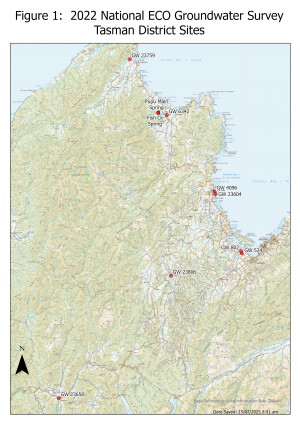
The results of the 2022 National Survey of Emerging Organic Contaminants (EOC’s) in Groundwater were recently released.
EOCs are natural or manufactured chemicals in household and personal care products, antibiotics and other pharmaceuticals, estrogenic steroidal hormones, lifestyle chemicals e.g., caffeine and nicotine, industrial compounds, compounds from plastic packaging (bisphenol A (BPA) and agrichemicals.
Tasman was part of the national survey with 12 of the Regional and Unitary authorities participating. Due to the laboratory delays with the EOC testing the final report was just completed with Tasman receiving the report on 9 July 2025.
The survey was co-ordinated nationally by Public Health and Forensic Science (PHF Science) previously ESR, with the sampling carried out by participating Councils for their respective regions. The sampling formed part of the pesticide and agrichemical testing which has been reported previously to Council.
Many of the EOC’s are related to materials used by humans. PHF Science note that nationally the EOC detection has significantly increased from the previous 2018 survey. There were also more tracers added in to the 2022 survey compared to the previous 2018 one.
Many of the EOC’s detected could be from near source entering shallow groundwater via sumps/drainage, leaching from wastewater systems and human contact e.g. suncreams etc with spring water sources.
A total of 115 wells, bores, springs were selected nationally, sampled and analysed. Most of the sites selected were from unconfined aquifers, recognising that shallower unconfined aquifers would be more at risk; several spring sites were also included in the survey.
The units reported for EOC’s are measured in parts per trillion (ppt re 10-12) or ng/L (nano gram per litre).
For context, 1 ppt is roughly a drop of water in 20 Olympic size pools.
Nationally 97.4 % of samples (or 112 out of 115 samples) from the survey had traces of EOC’s.
All 10 sites chosen in Tasman – taking in the Waimea, Motueka, Murchison and Golden Bay areas – also showed some level of EOC, with more than 70% of sites showing levels less than 5 ppt.
These are still incredibly small amounts when you consider the above comparison – so it’s important to bear this in mind when reading the results.
The Tasman samples were collected between November 2022 and in January 2023.
The EOC levels detected are low and there are no standards for acceptable levels for human or ecological needs. There is a lack of knowledge globally of the fate and effects of EOC’s. There is also little knowledge about their leaching properties through soils, transport through groundwater and there has been limited studies on their presence in NZ groundwater systems.
The full report from PHF Science can be found here (pdf 833 KB) (pdf, 833 KB).
The Tasman results table can be found here (pdf 116 KB) (pdf, 116 KB).
PHF Science are happy to be contacted with regards specific aspects of the survey and technical report. Contact: Dr Laura Banasiak - [email protected]