

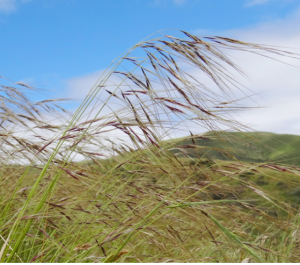
Chilean needle grass (Nassella neesiana) has been present in Marlborough since the 1940s and is a significant agricultural pest weed. It is now established at several sites in the Wairau Valley, with the westernmost occurrence in the Wye River Valley.
Our priority is to contain the infestation and prevent its spread into Tasman, the Nelson Lakes area and beyond.
Chilean needle grass has a very sharp spikelet that spreads by attaching itself to anything that brushes past the plant. Seeds are typically collected in the wool and hair of domestic stock.
The seed has an exceptionally long awn (tail) that acts like a corkscrew, winding the seed into the skin of the animal, causing it stress and discomfort.
Its seed heads can be confused with another widespread grass weed species, ripgut brome, whose seed heads are also capable of embedding in the skin of stock animals.
It is very difficult to identify when it is not seeding. It can look very similar to other pasture grass species, although it generally has a thinner, more pointy leaf.
The root system is bulbous, similar to nassella tussock. The seed is heavy and will generally fall close to the parent plant, building up a large number of seeds in the soil around the existing plants.
Seeds are spread predominantly through stock, people, vehicles and machinery. Stock feed, such as hay, is another way that seed can spread to new areas. Dirty earthmoving machinery is a high-spread risk due to the seed remaining viable in the soil for 12-plus years.
If you suspect that you have seen a plant anywhere in your area, please contact our Senior Biosecurity Officer, Lindsay Barber, on 03 543 7224.