

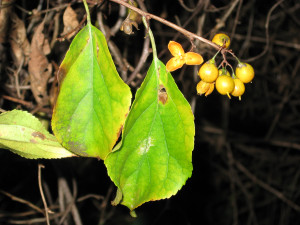
Climbing spindleberry (Celastrus orbiculatus), also known as oriental bittersweet, is a vigorous climbing vine. It was originally introduced to New Zealand for its golden autumn foliage and attractive winter berries, but has since become an invasive pest.
Climbing spindleberry is an eradication species under the Tasman Nelson Regional Pest Management Plan, meaning our Biosecurity Officers carry out control to eradicate it from our region.
Native to eastern Asia, climbing spindleberry is tolerant of cold conditions and has naturalised in several locations throughout the Nelson Tasman region.
A deciduous climber with suckering roots and round, woody, greyish-brown stems often with small knobbly warts (lenticels), the young green twigs often have sharp spindles (1 – 2 mm).
Its leaves are round to oval, finely serrated with an elongated tip, and 5 – 10 cm long, arranged alternately on the stem. The leaves are also identifiable by having a small woody spur at their junction with the stem. The green leaves turn yellow in April / May before falling.
Pale green, inconspicuous flowers are followed by round yellow to orange seed capsules (6 – 8 mm diameter), which split open to reveal fleshy red seed coverings and are present from late summer into autumn. These are highly attractive to birds, which helps spread the vine to new areas.
If you have climbing spindleberry on your property or think you have seen it around our region, please get in touch with our Biosecurity Team at [email protected] or on 03 543 8400.