

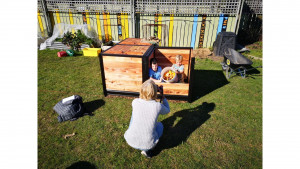
The Hope School community is now the proud owner of newly installed Carbon Cycle compost boxes, purchased with money from one of our Waste Minimisation Projects grants.
This compost infrastructure is one part of a big vision for sustainability and climate action education within the school.
These compost boxes will serve to process food scraps from the wider community, plus process their own food scraps and garden weeds generated through the Garden to Table programme.
Families will be given 10-litre buckets to collect their food scraps that would otherwise go to landfill, and small jars of Bokashi bran to inoculate with beneficial microbes and enable fermentation before being composted through these new rodent-proof bins.
As part of our Enviroschools Programme, we are also working with Hope School on new in-ground and raised veggie garden beds for spring planting. Plus, in partnership with the Roding Catchment Group, a native tree nursery is being built on the school grounds, to service conservation planting projects within the school and along the Roding River riparian.
Fingers crossed that the tree nursery will be finished in time for the Climate Action Festival in October, in which Hope School will be hosting a potting up party to kick off the propagation and growing of native trees.
We have waste minimisation grants available to support community initiatives that aim to minimise waste in Tasman schools, early childhood education centres or community groups, plus larger grants for innovative community projects.