

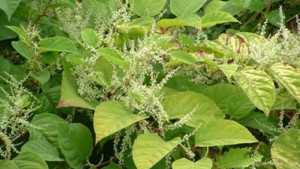
Asiatic knotweed (Fallopia japonica) is an invasive pest plant found growing throughout the Motueka Valley, with smaller infestations also present in the Riwaka and Wai-iti catchments.
Listed by the World Conservation Union as one of the world’s worst invasive species, our Biosecurity team has been running an eradication programme to control its spread.
Our efforts to date have focused on containing knotweed’s presence within the Motueka Valley, and we advise residents not to move soil and silt outside this area.
The flood events during winter 2025 posed significant risks of spreading Asiatic knotweed. Floodwaters moving through infested areas can break off rhizome fragments, which can be carried away in debris and deposited in silt. This kind of spread – while unintentional – threatens control efforts and may lead to further infestations.
Asiatic knotweed poses a significant threat to both natural ecosystems and infrastructure. It forms dense, long-lived thickets that smother native vegetation and prevent the establishment of other plant species.
It can also impact crops and impede water flow when growing along waterways. In urban areas, it has the ability to damage building foundations, force its way through cavities in walls, and damage drains and sewers.
One of its most concerning aspects is how easily it spreads. Even a very small fragment of rhizome can regenerate into a new plant, making it highly challenging to control.
If you do need to remove or relocate soil or flood debris from your property, or have done so already, please let us know. We also ask that you inspect and clean machinery, equipment and vehicles as much as possible.
For more information or to report a sighting, contact our Biosecurity team on [email protected] or 03 543 8460.