

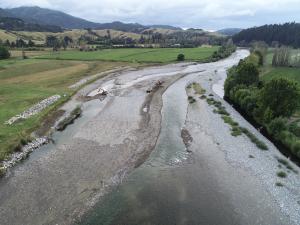
We have been hard at work on Tasman’s rivers since the June-July 2025 major flood events, and we have now established a programme of work covering the next 20 months that will progressively address flood-damaged areas.
Work is grouped into three broad categories of channel shaping, rock works (repairing and installing rock structures), and willow planting.
The programme is well underway, with a significant portion of early works already complete or in progress. Broadly, the programme is scheduled in several major phases:
- July 2025 to late 2025: Major river realignments and gravel relocation, and the first phase of rock work across most rivers.
- Summer and autumn 2026 (current focus): The peak period of physical works – rock repairs, new rock structures, and continued shaping – is happening now across many rivers.
- Winter 2026: Significant willow plantings in flood-damaged areas, and maintenance of existing willows to encourage new growth.
- Spring 2026 to Autumn 2027: Continuing with physical bank protection work in damaged areas – rock repairs and new rock structures.
- Winter to Spring 2027: Another major willow planting and maintenance programme over the winter months, with the main river recovery programme winding down in spring with completion of rock works on the more complex rivers (Motupiko, Tadmor, Upper and Lower Motueka, Wai-iti).
The specific areas we are working on include complex programmes at Dove River and the aforementioned larger rivers.
Smaller, targeted works are also planned for Tākaka, Moutere, Sherry, Wairoa and Waingaro Rivers – right down to limited intervention work at Pigeon Valley Stream.
River-by-river summary
Dove River: One of the more complex programmes. Initial response was carried out immediately after the flood, with some key sites completed, such as the work upstream of the Dovedale Road Bridge near Sunday Creek. Wide-scale shaping work began in early 2026, and rock works — including both repair of existing structures and installation of new assets — have been following in behind and will continue through 2026 and into 2027. Willow planting and maintenance are scheduled to continue through the 2026 planting season on the critical front-line defence. Further resilience plantings are planned each season into the foreseeable future.
Motueka River (Lower Reaches): A relatively focused programme. Shaping and rock works were concentrated in late 2025 and early 2026, with the bulk of physical works largely wrapping up around mid-2026. This is one of the earlier-completing reaches in the programme with a focus on large sites to protect large areas of highly productive land and residential dwellings. A further programme of works is planned in the lower reaches for mid-late 2026 with gravel extraction and smaller site flood repairs.
Motueka River (Upper Reaches): A longer and more involved programme than the lower Motueka given the inherent complexity of the upper reaches. Rock works — particularly new asset construction — extend well into 2027 with a focus on strategy to achieve long-term resilience. The upper Motueka is the largest programme of works. Planting maintenance and willow establishment are scheduled through mid-2027.
Motupiko River: The Motupiko is a key tributary to the Motueka River, and as such requires careful planning to ensure works achieve the positive outcomes intended. Shaping work runs from early 2026 through into early 2027, and rock repair and new asset works extend through to late 2027. Planting is planned toward the latter end of the programme, in mid-to-late 2027. This river will be an active worksite, on and off, for much of the remainder of the programme period.
Moutere River: A more modest scope of works given the relatively lower level of damage this river received during the flooding, with several key stabilisation projects having already been completed. The definitive programme on this river will be established and consulted through early 2026. Rock repairs and new rock structures are scheduled primarily through late 2026, with willow planting in the 2027 season.
Sherry River: A targeted programme focused on new rock asset works, largely concentrated in late 2025 and early 2026 with a few key repair sites now complete.
Tadmor River: A significant and long-running programme, as this river was severely damaged during the flood events, not dissimilar to the Dove River. Shaping work started in late 2025, with the majority of priority sites completed in early 2026. Lower priority work will carry through 2026 and continue through to early 2027. Rock works — both repairs and new assets — run throughout 2026 and into late 2027. Planting and willow establishment are spread across 2026 and into 2027, with this river receiving priority planting in the 2026 season.
Tākaka River: Given the limited flooding in Golden Bay, rock repair work is focused around 2026, representing a targeted intervention rather than a long-term programme. This is to deal with both historic damage and the few sites that were damaged in the June-July 2025 floods.
Wai-iti River: An extensive programme with shaping work running from late 2025 through most of 2026, followed by rock works extending well into 2027. This river was severely damaged throughout its length from the Stock Road Bridge down to the confluence with the Waimea River. Significant damage occurred upstream of the Quail Valley Bridge, through to Wakefield-Kohatu Highway bridge, which will be an area of focus in early to mid-2026. Some willow planting works occurred immediately after the flood, with further plantings planned for the 2026 season and a larger programme scheduled for the latter stages of the programme in 2027.
Waingaro River: Similar to the Tākaka River, flood damage was limited to a few key sites. These sites, along with some historic damage, will be addressed with a focused rock repair intervention, scheduled around mid-2026.
Wairoa River: The Wairoa River fared well with the flood events, with no widespread or severe high-risk damage. Some new rock asset works are planned for mid-2027 to increase resilience within the more vulnerable areas, representing a later-stage intervention in the overall programme.