In December 2025, the Crown signed a Resolution Agreement concluding a private property law claim relating to a historic land ownership agreement. Read the announcement here(external link).
The agreement sees some land currently being used by the Crown in the Nelson/Tasman area being fully restored to it's owners (represented by Te Here-ā-Nuku Trust). Land owned by the Trust is indicated in red on the map below. Click here to open the map in a new window [JPG, 1 MB].
New legislation has been developed to ensure the Resolution Agreement works in practice.
Te Here ā Nuku (Nelson Tenths) Bill was introduced to Parliament on Monday 22 June to enable the transfer of land from the Crown to Te Here-ā-Nuku Trust. Read more here from the Attorney General and Conservation Minister(external link).
The Bill allows title to be raised for the rightful owners. Both the Crown and Te Here-ā-Nuku Trust are committed to a seamless transfer of landownership.
Get more information on the Te Here-ā-Nuku Trust website(external link).
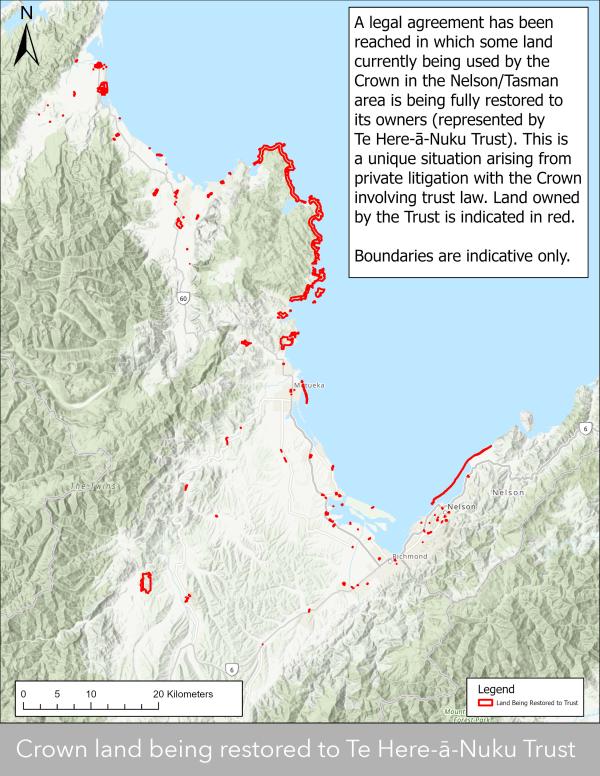
Land owned by the Trust is shown in red
Click here to open the map in a new window [JPG, 1 MB].
This is a private litigation case relating to trust law and private property ownership. It is not a Treaty settlement.
Between 1839 and 1841, the New Zealand Company purchased land in and around Nelson, Golden Bay and Tasman Bay. As part of the arrangement with Te Tau Ihu Māori, payment was to include the setting aside of one-tenth of the planned settlement (15,100 acres (6,110 hectares)) for the benefit of the original owners and their descendants, and that pā, urupā and cultivation lands be excluded.
In 1845, the Crown assumed the Company’s obligations. However, the Crown failed to reserve and exclude the full amount of land as agreed. As a result of this, and subsequent transactions, there is a shortfall of approximately 11,715 acres (4,740 hectares) of the 15,100 acres (6,110 hectares) that should have been reserved.
Mr Stafford first raised this issue with the Crown 39 years ago. This private law litigation began in 2010, when Kaumātua Rore Stafford and others brought a case against the Crown in relation to the Nelson Tenths scheme.
In 2017 the Supreme Court concluded the Crown had a duty to reserve the Nelson Tenths land for the benefit of the original owners. It referred the case to the High Court to decide the extent of the Crown’s breaches, defences and appropriate remedies.
In October 2024, the High Court found partly in favour of the plaintiff, confirming the land belongs, and always has belonged, to the descendants of the original owners. The Court determined that the Government must return title to the land or compensate the plaintiff if it could not do so.
Of the 15,100 acres (6,110 hectares) that should have been reserved as part of the Nelson Tenths, 8,033 acres (3,250 hectares) are currently being used as core Crown land, mostly by the Department of Conservation.
In August 2025, the two parties began formal, confidential discussions with a view to settling the litigation.
In November 2025, the parties reached an agreement which settles the case and provides certainty for all parties.
The agreement comprises two parts:
The agreement does not affect any privately owned land.
What is this litigation about?
This is a private litigation case between the Crown and Kaumātua Rore Stafford, on behalf of the original owners. The case is based on trust law and the ownership of specific areas of land in the Nelson, Tasman and Golden Bay areas. The Court has found in favour of Mr Stafford, that the land in question is not owned by the Crown but rather has been held on trust by the Crown for the benefit of the original owners since 1845.
What land is affected by this litigation?
The affected land (8,033 acres (3,250 hectares) includes approximately 5,000 acres (2,023 hectares) of public conservation land. No privately owned land is affected.
Why isn’t this a Treaty of Waitangi settlement?
The litigation leading to this agreement is all about the private law of trusts and property. It is not a ‘Treaty’ case. The agreement is about the confirmation of the private property rights of a large number of individual beneficiaries of a trust.
In contrast, Treaty settlements settle historical claims relating to acts and omissions of the Crown that breach the principles of the Treaty. Settlements are political and moral in nature, not based on hard legal principles, and are made with iwi as collectives representing the traditional groupings, not with individuals.
The agreement results in the restoration of land and cash assets to a trust, not the payment of compensation to iwi for breaches by the Crown of its Treaty obligations.
The Court in this case specified that “this is not a claim for breach of the Treaty”. The Court also cautioned that “care must be taken to ensure this essentially private law claim does not morph into a public law claim”.
Why has this court case taken so long?
This is a trust law case about property rights, which involves historic records and circumstances. The timeframe reflects the time required by the Crown and plaintiff to research and prepare their case, as well as the time involved with legal proceedings, appeals, hearing schedules, and decisions.
Can other original owners, iwi or hapū take a similar court case?
Although people are entitled to bring litigation to the courts, the facts of this case relate to very specific, historical circumstances which would not easily be replicated elsewhere.
How did the agreement get worked out?
In August 2025, the two parties entered into negotiations to reach a suitable agreement. The Attorney-General appointed the Rt Hon Dame Patsy Reddy and David Tapsell as her representatives to lead the agreement negotiations for the Crown, supported by Crown Law Office and Te Puni Kōkiri. Te Here-ā-Nuku trustees led the negotiations on behalf of the original owners.
Is Mr Stafford now the owner of the land?
In October 2024, the High Court determined that the original owners of the land are the descendants of the tūpuna named in a list produced by the Native Land Court in 1893, as well as the descendants of specific Kurahaupō tūpuna.
Mr Stafford has representative status on behalf of the original owners for the purposes of the litigation.
As part of the agreement, land and financial compensation will be transferred to Te Here-ā-Nuku Trust, which will hold the land and money as trust assets on behalf of the descendants of the original owners.
What is Te Here-ā-Nuku Trust?
Te Here-ā-Nuku Trust has been established to support the litigation and ultimately hold the trust assets. Mr Stafford, representing the descendants of the Māori original owners, is the plaintiff. Following the High Court’s decision in 2025 to remove the Crown as Trustee of the lands, Mr Stafford and 13 other original owners were named as trustees of Te Here-ā-Nuku Trust.
Where is the money coming from to pay for this agreement?
Crown funds will pay to meet this legal obligation. The expense was recognised in the Government's books in 2024/25 when the Courts ruling created the obligation, as outlined in the Financial Statements of the Government for 2024/25.
How much is being paid?
The financial component of the agreement is a one-off payment of $420 million. This represents the shortfall of land that was no longer held by the Crown and therefore the trust was not able to be restored in full.
What happens to the Abel Tasman Track after 25 years?
It is intended that there be a review in 25 years to allow the arrangements that have been negotiated to be considered. The trustees have confirmed that they share an interest with the Crown on commitment to biodiversity and conservation outcomes.
Today’s focus is on the signing of the resolution agreement, which sees the Crown rectifying a legal issue dating back to 1845. The 25-year arrangement for the areas of Abel Tasman in question provides certainty for national park users. Beyond that, both parties view this a long-term, enduring relationship and our aspiration is that we will continue to work together closely to protect this important and special area for our local community and visitors.
Some schools are on this land. Will they stay in the same location?
Yes. The parties have agreed that all schools will continue to operate where they sit under specific lease agreements, with the Crown retaining all school buildings and fixtures on the land. Any change to schools in the area remains the business of the Ministry of Education, and any future changes due to rolls or other operational matters remain the purview of the Ministry of Education.
What is the history of the Nelson Tenths?
Between 1839 and 1841, the New Zealand Company purchased land in Te Tau Ihu for its planned settlement in and around Nelson, Golden Bay and Tasman Bay. As part of the arrangement with Te Tau Ihu Māori, payment was to include the setting aside of one-tenth of the planned settlement as reserves for the vendors.
Following the signing of Te Tiriti o Waitangi | the Treaty of Waitangi in 1840 and the enactment of the Land Claims Ordinance 1841, the New Zealand Company’s purchase no longer had legal effect and required Crown validation.
William Spain was appointed as a commissioner in January 1841 to investigate the New Zealand Company’s purchases. He recommended that 151,000 acres (61,107 hectares) of land located in and around Nelson, Tasman Bay, and Golden Bay be granted to the New Zealand Company, on the condition that 15,100 acres (6,110 hectares) (a tenth) be reserved for the benefit of the customary owners of the land and their descendants, and that pā, urupā and cultivation lands be excluded from the grant.
The Crown accepted Commissioner Spain’s recommendations but failed to reserve and exclude the full amount of land as agreed. Further, upon the New Zealand Company’s failure in 1850, the Crown assumed the Company’s obligations and took its land. As a result of this, and a number of other transactions in the mid-19th Century, there is a shortfall of approximately 11,715 acres (4,740 hectares), of the 15,100 acres (6,110 hectares) of the land that should have been reserved, and of other land that should have been excluded.
Last modified: